
“A fly? You must be kidding me!” Well I am not really taking about the normal house fly which looks like this:
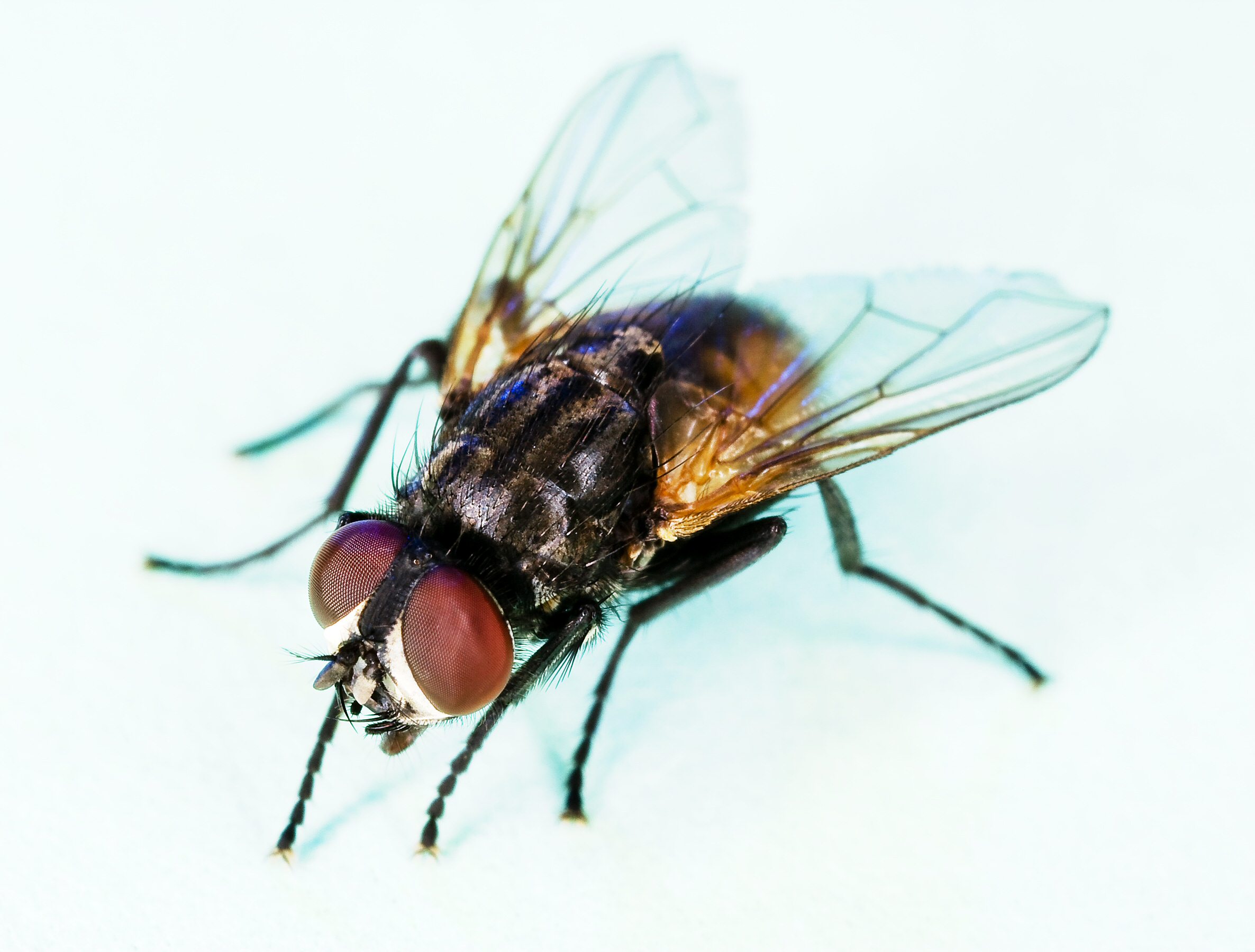
Image credits: Wikipedia
I am talking about the Tsetse fly which looks like this:

Image credits: The New York Times
Now, the Tsetse (pronounces as: see see) fly is native to the tropical Africa and is well known for spreading the disease called Human African Trypanosomiasis. This fly serves as a vector for this disease. What does a vector mean? It means that it is a carrier for the disease. This fly can be mistaken for a normal house fly for its resemblance of the size (8 – 17 mm) however, its other anatomical characteristics make it distinguishable from the house fly.
What exactly is the disease? Trypanosomiasis, as the name suggests, is more commonly called the sleeping sickness. It is a parasite mediated disease where the person has severe sleep disturbances along with other symptoms and involvement of the central nervous system which makes this disease fatal if left untreated. This disease can be divided into two different stages.
In stage one (haemolymphatic) : the person experiences fever, headaches, muscle and joint pain and inflammation of the lymph nodes. Stage two (neurological) develops after several weeks or months and involves the brain and the spinal cord. It is this stage where the person experiences personality changes and changes in the sleep pattern.
The parasite involved in this disease is called a trypanosome. Trypanosomes are unicellular parasitic protozoa which have quite a few number of species and sub-species. Out of these only 6 species are recognised as the causative agents of the sleeping sickness and for humans specifically, only 2 sub-species can cause the disease. These are the subspecies of Trypanosoma brucei brucei, namely Trypanosoma brucei gambiense and Trypanosoma brucei rhodesiense (WHO, 2020).
Image credits: CDC

Image credits: Yourgenome.org
The image below shows a great representation of the Tsetse fly lifecycle – the mammalian stages as well as the fly stages
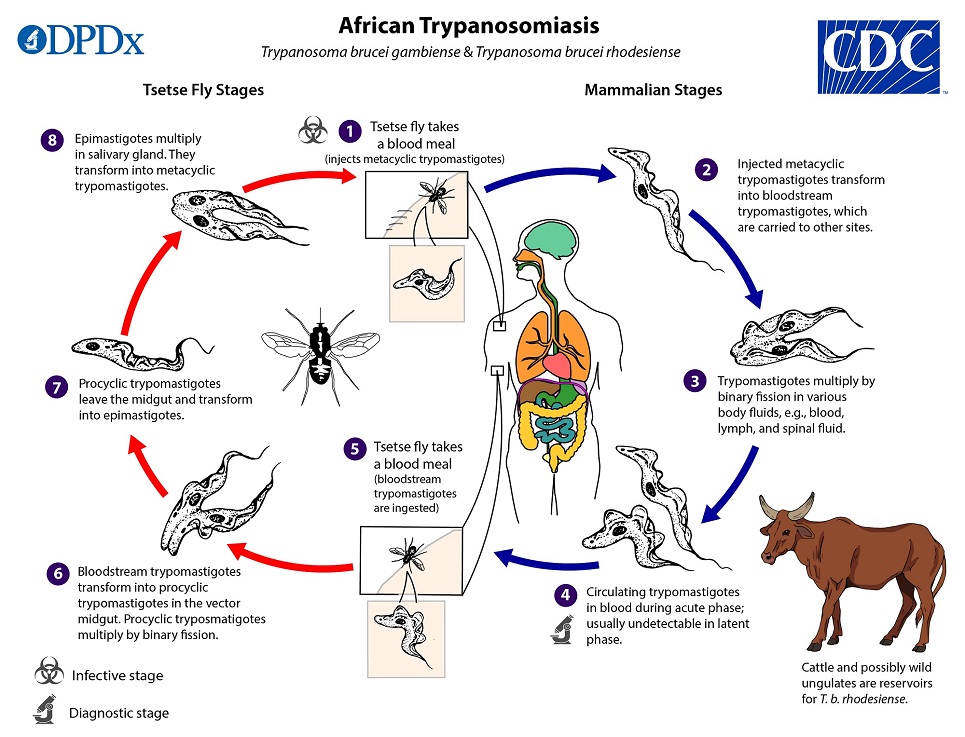
Image credits: CDC
Now let us understand what happens inside the body:
After being bitten by the fly, it takes one to two weeks for the trypanosomes to multiply significantly in the blood before they cause the symptoms. So lets say the incubation period for the parasite is 1-14 days. Once they are freely circulating, they start infecting the lymph nodes and the spleen. These organs become swollen and tender. Now, you can see the first sign of the disease called the Winterbottom’s sign where there is a marked enlargement of the lymph nodes at the back of the neck. There is onset of irregular fever and delayed sensation to the pain. More complex symptoms develop when the fly invades the blood brain barrier. This causes neurological symptoms like severe headaches, dullness, tremors and paralysis. The severity of the disease increases when the symptoms evolve into coma resulting in death of the patient (Encyclopaedia Britannica, 2020)
Now, this disease is definitely fatal if not treated. There are many treatment options available and it is completely curable but what’s interesting is, this little fly can actually kill you.
References:
https://www.who.int/trypanosomiasis_african/disease/en/

 THE BIO BOOK
Wow! Interesting and really cool.
Never a knew a tiny fly could kill you.
LikeLiked by 1 person
Yep haha
LikeLiked by 1 person
Wow, great informative post Krishnani, and nice blog. Keep up the good work dear.
LikeLiked by 1 person
Thank you!
LikeLike
Pleasures is mine Krishnani 🌹
LikeLiked by 1 person
Hey!
How come no posts? It’s been a long time…
Hope you’re doing good 🙂
LikeLike
Hey! Apologies for the disappearance. I shifted to another Country and was busy settling down. Will start writing soon! Thanks for following up! Thats very sweet of you 🙂
LikeLike
Oh…
Hope everything is going good??
LikeLiked by 1 person
Yup all is good. Thank you 😁
LikeLiked by 1 person
Excellent Blog Krishani
LikeLiked by 1 person
Thank you!
LikeLike