
First of all, its been a long time since I have posted anything. I was very busy with my first semester so could not write anything.
We are going to talk about how vaccines work! For that, we need to know what vaccines are first of all. Vaccines are actually a way of introducing an enemy to your immune system. It’s like we secretly tell out immune cells that if this pathogen ever invades and tries to attack you, kill it right away. All these pathogens are unique and what makes them unique are the “antigens” which are the proteins present on the pathogens. When we introduce these antigens into the body, our immune cells recognise them and produce “antibodies” against them. So when this pathogen tries to invade again, we already have antibodies that will recognise and directly kill them off.
You might be wondering if we introduce the antigens of the pathogen, would it not infect us and what if our immune cells can’t fight it and we end up getting sick? Is that not a risk? Well, not exactly because we always introduce the antigen in a form where it is so weak that it can only raise an alarm in the immune system that ‘hey someone is here’ but doesnt really have the capacity to cause damage.
There are a lot of different types of vaccines used for different purposes:
| Live attenuated | Inactivated | Conjugate |
| Weak or asymptomatic form of bacteria or virus | Dead cells of the pathogen are introduced into the body | A specific part of the pathogen like a protein or a carbohydrate from is injected into the body |
| Too weak to cause an infection and gives chance to immune cells to recognise it | Immune cells can recognise the antigens | Immune cells can recognise the antigen and learn to fight it |
| Lifelong immunity with one- two doses | Vaccines can be freeze dried and stored for long term use | Lower chance of an adverse reaction |
There are some disadvantages of these vaccines as well. The live attenuated vaccines cannot be given to people with a weakened immune system as we would be injecting the whole pathogen. The inactivated vaccine might not have a robust response as the pathogen is activated and hence the immune system is not getting the complete real stimulation. As far as the conjugate vaccines are concerned, identifying the specific proteins of the pathogen that can illicit a response is not possible always.
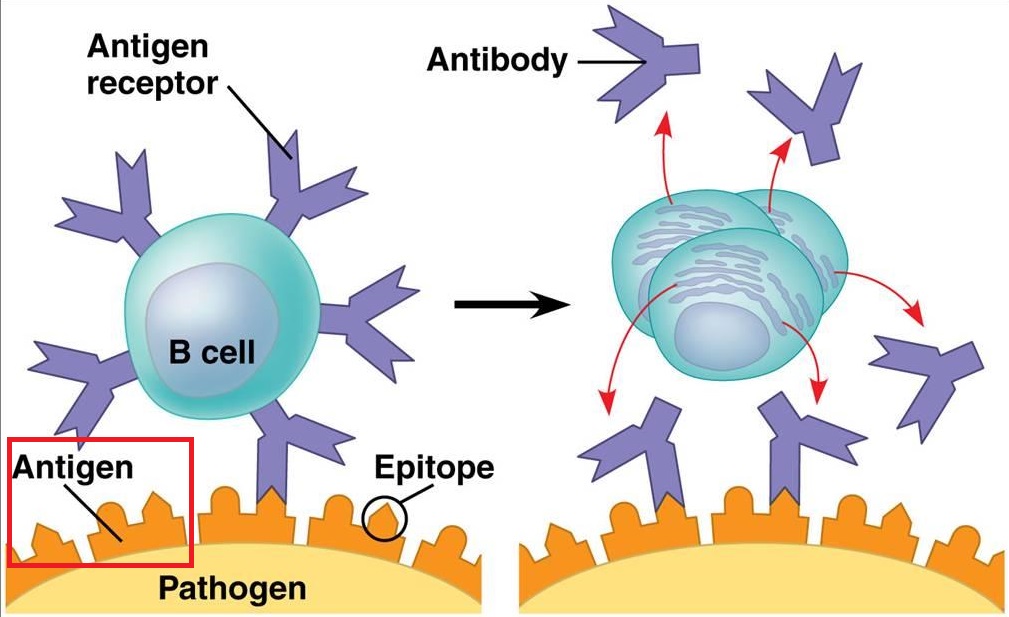
Now that we know about the vaccines and pathogens, lets see how the antibodies work in recognising the antigens. This might be a little too detailed but you’ll realise how complicated our immune system actually is.
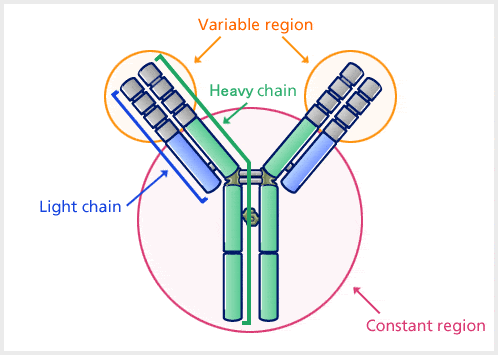
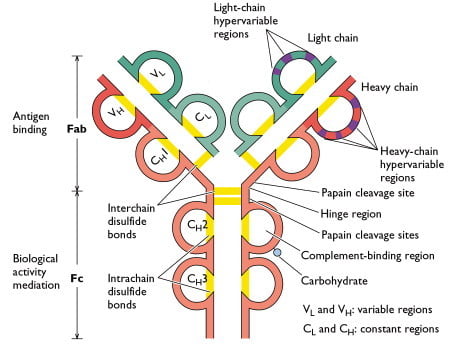
As we can see in figure 2, there are 2 main regions of an antibody: the region that remains constant (constant region) and the region that varies according to the type of pathogen (variable region). Each antibody is made up of a unique set of a heavy chain and a light chain.
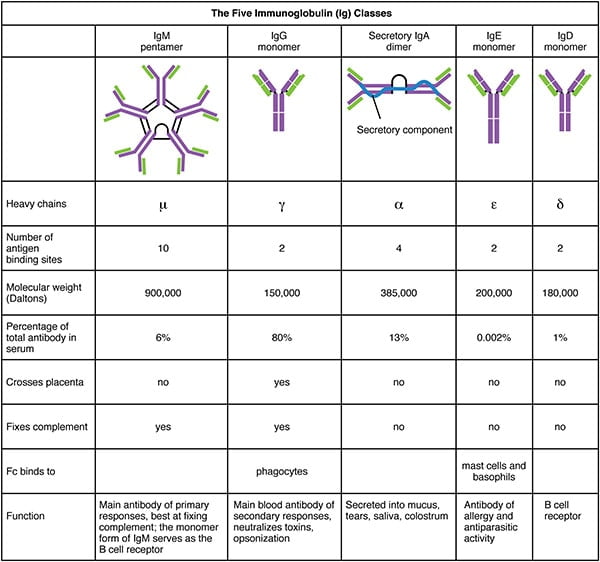
As we can see there are five different types of antibodies also called immunoglobulins (Ig) G A,M,D and E. There are their functions:
| IgG | IgA | IgM | IgD | IgE |
| long term (months and years) and general protection against pathogens and also triggers complement protein system | Binds before antigens invade tissues and keeps the antigens in secretions for easy recognition when it infects again | Involved in ABO blood group antigens on RBC surface and enhances phagocytosis | Present in the surface of B cells and plays a role in production of antibodies | Binds to mast cells and basophils to promote release of granules to kill the pathogen and may be involved in parasite killing |
As we can see, these various antibodies have different functions and they are so important in recognising the antigens and remembering them!
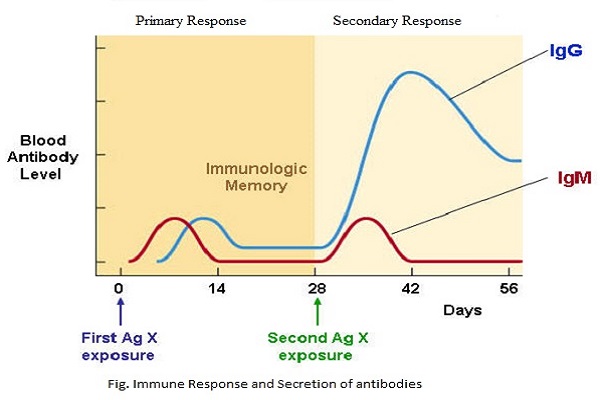
As we can see, if the antigen is a new enemy, IgM is triggered first and after about 4-5 days, IgG is triggered, whereas if the same antigen comes in again, the IgG shoots up and kills it off as it has the immunologic memory of that particular antigen. As observed in figure 5, the secondary response is much more stronger than the primary response. This is what vaccines do as well so when the same antigen enters, the body is sensitised to it already and thus, the IgG kills it off!
I hope you enjoyed reading this blog! Hail the immune system!
References:
https://www.publichealth.org/public-awareness/understanding-vaccines/vaccines-work/

 THE BIO BOOK
Awesome post!!!
LikeLiked by 1 person
Thank you so much! Means a lot!
LikeLiked by 1 person
❤
LikeLiked by 1 person
Gani Very good article and explained very precisely It is a good article for Medical graduates also
-Nana
Sent from my iPhone
LikeLiked by 1 person
Thank you so much Nana! Glad you liked it!
LikeLike
Just when you thought you knew what antibodies and vaccines were…Lolz! Amazingg post !!
LikeLiked by 1 person
Thanks! Glad you liked it!
LikeLiked by 1 person